
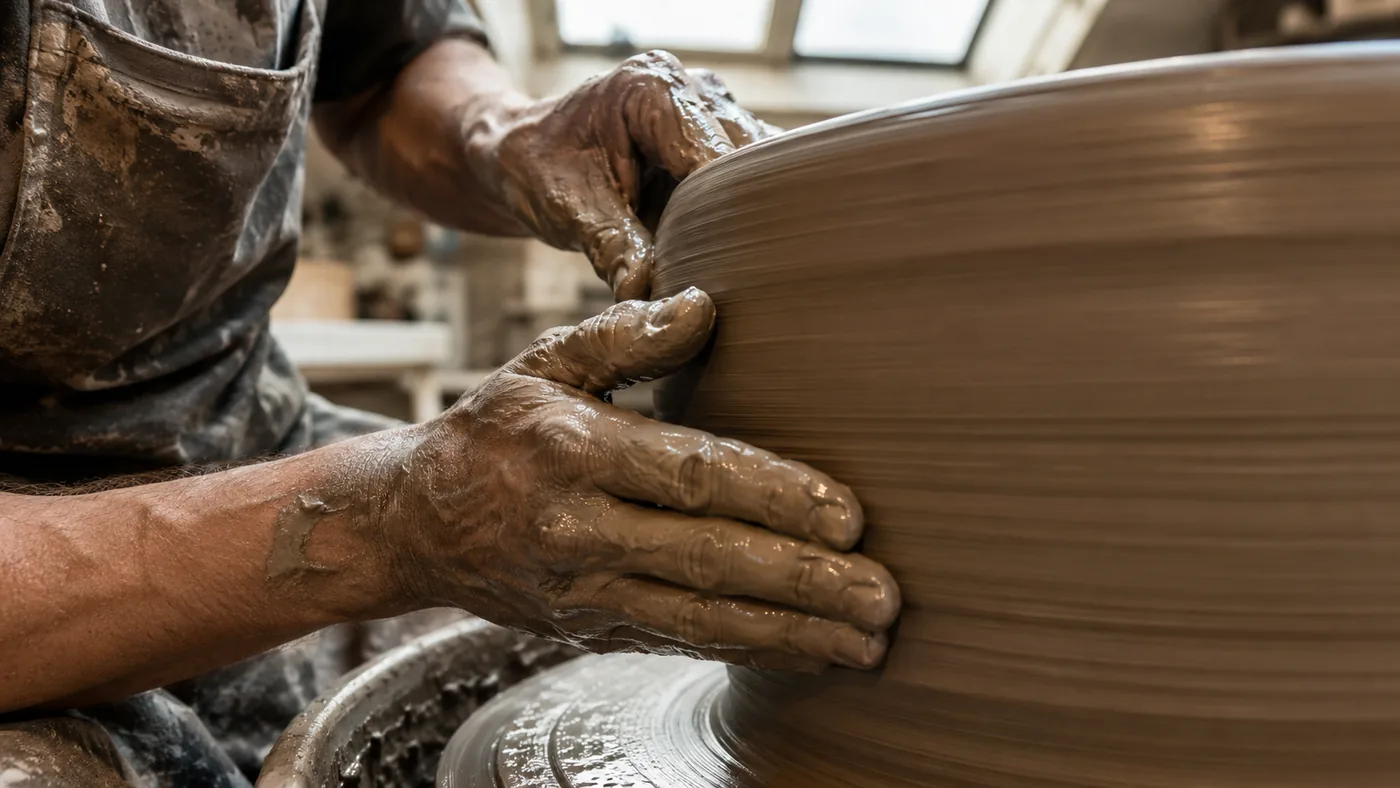
Something has shifted in the way we think about luxury interiors. The polished, the perfect, the factory-finished — these were the markers of high-end design for decades. A marble surface without blemish. A sofa upholstered with machine-precise seams. Chrome fittings that caught the light with surgical exactness. But a new sensibility is emerging, one that finds beauty in the evidence of the human hand, and nowhere is this more apparent than in the quiet revolution taking place in contemporary ceramics.
Walk into any of London's more forward-thinking design showrooms and you will notice the change. Where once there were rows of identical porcelain, there are now shelves of pieces that are proudly, deliberately imperfect — vessels with thumbprints still visible in the clay, glazes that pool and drip in unrepeatable patterns, forms that wobble with the confidence of objects that know they are one of a kind.
The Wabi-Sabi Influence
The Japanese concept of wabi-sabi — finding beauty in impermanence and imperfection — has been discussed in Western design circles for years, but it is only now being genuinely absorbed rather than merely referenced. The ceramic arts are its most natural medium. A raku-fired bowl, pulled from the kiln at 1,000 degrees and cooled in sawdust, carries the record of its own making in every crack and colour shift. No two are alike. Each is, in the most literal sense, unrepeatable.
This unrepeatable quality is precisely what the luxury market now craves. In an era of algorithmic curation and mass customisation, the genuinely handmade has acquired a new aura. As the Crafts Council has documented extensively, demand for studio ceramics has risen sharply over the past five years, driven by interior designers seeking pieces that bring texture, warmth, and individuality to spaces that might otherwise feel sterile.
From Studio to Interior
The most interesting work is happening at the boundary between art and function. A ceramic wall installation by a trained sculptor brings a gallery sensibility to a residential dining room. A hand-thrown washbasin transforms a bathroom from a utilitarian space into a moment of daily beauty. Tile work by contemporary ceramicists — with its irregular edges and hand-painted glazes — gives kitchens and bathrooms a character that no mass-produced tile can match.
Several luxury hotels have led the way. Properties in Japan, Scandinavia, and increasingly Southeast Asia are commissioning local ceramic artists to create bespoke pieces for their interiors — from tableware used in restaurants to large-scale installations in lobbies and public spaces. The effect is to root the hotel in its place, to give it a material identity that cannot be replicated in another location.
The Economics of the Handmade
There is, of course, a tension at the heart of this movement. Handmade ceramics are expensive because they are slow to produce. A single large vessel might take weeks from throwing to final firing. Glazes are developed through years of experimentation. The economics of studio ceramics do not scale in the way that the luxury market typically demands.
Yet this scarcity is part of the appeal. In a world where almost everything can be reproduced, the truly handmade object carries a kind of moral weight — it represents time, skill, and attention in their most concentrated form. To place such an object in a room is to make a statement about values as much as aesthetics.
The shift is best understood as a change in what counts as a flaw. For most of the last century, luxury meant the elimination of variation: identical tiles, seamless surfaces, a finish so even it betrayed no hand at all. The current taste inverts that almost exactly. The slight wobble in a thrown rim, the pooling of glaze at the foot, the colour that shifted in the kiln - these are now read as evidence rather than error, and their absence is what looks cheap.
Part of this is a straightforward reaction to how easily the perfect version can be faked. When a printed laminate can imitate marble convincingly at four metres, the value migrates to the things that cannot be printed. A hand-thrown pot carries information a photograph struggles to transmit - weight, temperature, the way the surface takes light from two directions at once - and that resistance to reproduction is precisely what makes it desirable.
Architects and designers have responded by commissioning rather than specifying, which is a meaningful change in how the work gets made. Instead of selecting from a catalogue, a studio is briefed: two hundred tiles for this wall, glazed to catch the western light, variation welcomed. The results are slower and more expensive and occasionally do not work, and the risk is now part of what is being bought. It also means the maker's name attaches to the room, which was not true of a tile order in 1995.
The materials argument runs alongside the aesthetic one and reinforces it. Clay is abundant, local, and long-lived; a well-made piece outlasts several renovation cycles and can be repaired rather than replaced. Firing is energy-intensive and nobody serious pretends otherwise, but set against a decade of disposable finishes the accounting tends to favour the pot. For clients who care about that, it is a rare case where the beautiful choice and the durable one coincide.
There is an obvious danger in all this, and the better studios talk about it openly. Once imperfection becomes the signal of value, imperfection can be manufactured - the deliberate wobble, the artfully uneven glaze, handmade as a styling decision rather than a fact. The distinction is not always visible in a photograph, which is part of the problem. It is, however, usually obvious in the hand, which returns us to the point: this is work that has to be encountered rather than viewed.
The ceramic revolution in luxury interiors is, at its heart, a story about what we want our homes to feel like. Not showrooms. Not magazines. But places where the evidence of human making — imperfect, individual, irreplaceable — is allowed to exist.