
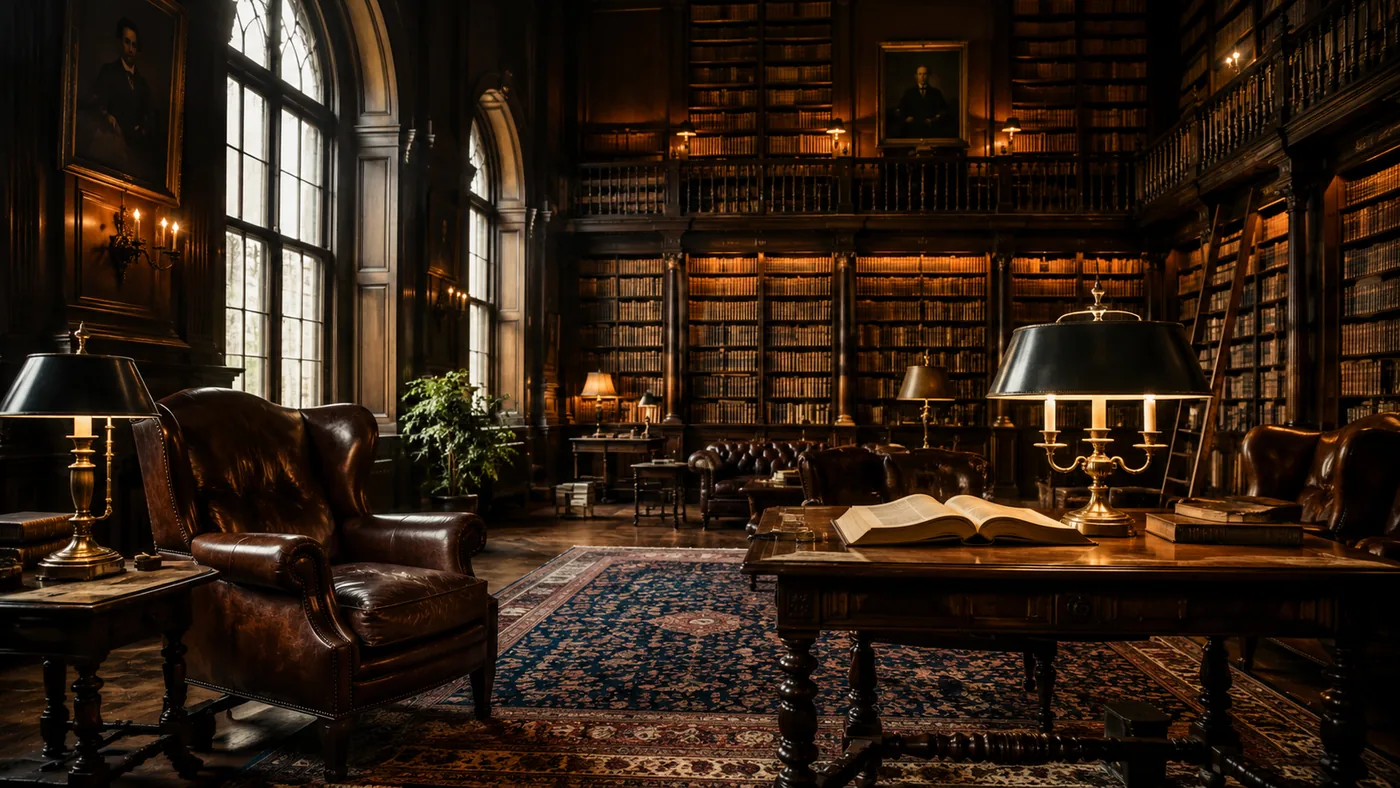
The reading room was once the intellectual heart of the home. In the Georgian townhouse and the Victorian country seat alike, it occupied a privileged position — a room dedicated not to display or entertainment but to the quiet, solitary act of engaging with the written word. Its decline over the twentieth century tracked the broader retreat of reading from the centre of cultural life. But something interesting is happening: the reading room is coming back.
Not as a museum piece or a nostalgic gesture, but as a functional space reimagined for contemporary life. Architects, interior designers, and hoteliers are rediscovering what earlier generations understood intuitively: that reading requires its own architecture, and that a room designed for concentrated attention is fundamentally different from one designed for socialising, working, or sleeping.
A Room of One's Own
Virginia Woolf's famous argument for a room of one's own was about creative independence, but it applies equally to the act of reading. To read seriously — to give a book the sustained attention it deserves — requires a degree of environmental support that the open-plan living room, with its competing screens and ambient noise, rarely provides.
The essential elements of a good reading room have changed remarkably little since the eighteenth century. Good natural light, supplemented by carefully positioned task lighting. Comfortable seating that supports long periods of concentration. Acoustic separation from the rest of the house. And books — not as decoration, not as background texture, but as the room's reason for being. As the history of the reading room reveals, these principles have been refined over centuries in libraries, monasteries, and private houses across Europe.
The Hotel Reading Room
Some of the most compelling contemporary reading rooms are being created by hotels. The trend reflects a broader shift in luxury hospitality away from pure leisure towards cultural enrichment. A well-stocked library with deep armchairs, good coffee, and an atmosphere that discourages conversation — this is increasingly what the most discerning travellers seek.
The best hotel reading rooms are curated rather than merely stocked. Their shelves reflect the local culture and landscape. A property in the Lake District might focus on Romantic poetry and landscape writing. A hotel in Tokyo might collect works on Japanese aesthetics and craft. The effect is to create a space that is simultaneously universal — reading rooms share a grammar that transcends geography — and deeply specific to place.
Design Principles
The contemporary reading room borrows from several traditions. The English country house library contributes the idea of books as architectural element — floor-to-ceiling shelving that doubles as insulation, creating a space that is both visually rich and acoustically quiet. The Japanese study contributes the principle of minimalism — a single desk, a view of a garden, nothing that does not serve the act of concentration. The Scandinavian hygge tradition contributes the emphasis on warmth and texture — wool, wood, soft light.
What unites these traditions is an understanding that the reading room is not a luxury but a necessity. In an age of constant distraction, the dedicated space for reading — quiet, comfortable, deliberately analogue — represents a form of resistance. It says that this activity matters enough to deserve its own architecture.
Building Your Own
A reading room need not be a separate room. A corner of a bedroom, a section of a hallway, a window seat with good light and a nearby shelf — any of these can serve the purpose if designed with intention. The key is separation: the reading space should feel distinct from the rest of the house, a threshold that signals a different kind of attention.
The obvious explanation is the screen, and it is at least half right. A room organised around books is a room organised against interruption, and the appetite for that has grown in exact proportion to how difficult it has become to find anywhere else. What is striking is how physical the response has been. People are not asking for a reading app; they are asking for a chair, a lamp, a door and a rule about phones.
Designers have noticed, and the results vary. The failures are the ones treated as set dressing - shelves filled by the metre with matched spines nobody has opened, a wing chair positioned for the camera, lighting that makes reading actively unpleasant after dusk. The successes are far less photogenic and considerably more used: a decent task light over the shoulder, a small table for a cup, a surface for the book you are halfway through, and enough acoustic softness that the room feels quiet rather than merely silent.
Hotels have taken to the idea with some enthusiasm, partly because it solves a real problem. The lobby is social and the bedroom is private, and there has long been nothing in between - nowhere to sit alone for an hour without buying a drink or lying on a bed. A well-run reading room fills that gap, and unlike a business centre it does not date. The good ones are staffed lightly, stocked with things actually worth reading, and firm about keeping laptops elsewhere.
The domestic version is more interesting still, because it usually involves reclaiming rather than building. A landing wide enough for a chair, a spare bedroom nobody sleeps in, the end of a hallway with a window. What makes it work is rarely square footage; it is having somewhere the household understands as the quiet place, and a shared willingness to respect it once someone is sitting there.
Underneath the aesthetics there is a straightforward argument about attention. Sustained reading is a skill that decays without practice, and practice requires conditions - a place where the phone is not, where the interruption does not arrive, where beginning a long book does not feel faintly absurd. The reading room is not nostalgia for a Georgian ideal. It is a piece of infrastructure for a habit that most of us would like to keep.
The return of the reading room is, at its heart, a story about values. It reflects a growing recognition that the life of the mind requires material support — that thinking, like cooking or sleeping, benefits from a space designed for the purpose. In dedicating a room to reading, we declare that the examined life is not merely a philosophical ideal but a practical commitment, written in bookshelves and lamplight.