
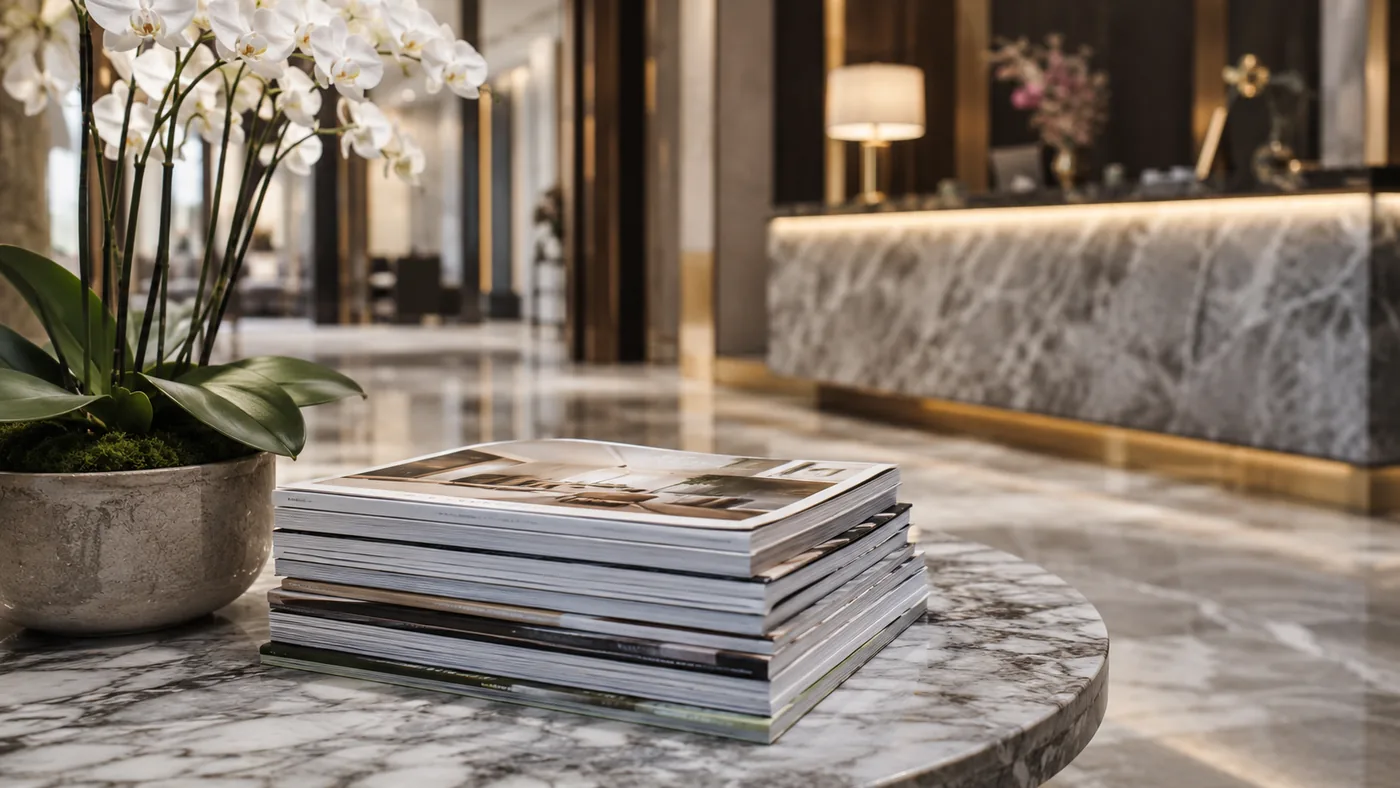
Somewhere between the lobby and the library, the luxury hotel decided it wanted to be a publisher. Not in the trivial sense of producing a glossy in-room magazine filled with advertorial — that tradition is as old as the minibar. What is happening now is more ambitious and more interesting: hotels are commissioning original writing, curating editorial programmes, and producing publications that stand on their own merits as cultural objects.
The trend is most visible in the boutique and independent sector, but it has spread to the larger groups as well. Aman publishes a journal of quiet sophistication. The Hoxton produces a free newspaper with genuine editorial credibility. Ace Hotel has long positioned itself as a cultural platform that happens to have rooms. The question is why — and what this convergence of hospitality and publishing tells us about both industries.
The Content Turn
The obvious answer is marketing. In a world where every hotel has a beautiful Instagram feed and a polished website, editorial content offers differentiation. A well-written essay about the history of a neighbourhood does more to communicate a hotel's sensibility than a hundred photographs of its interiors. It signals that this is a place that thinks, that reads, that cares about context as much as thread count.
But the phenomenon goes deeper than brand strategy. The best hotel publications reflect a genuine editorial curiosity — a desire to explore the culture of the places in which they operate. When a hotel in Kyoto commissions a piece about the philosophy of Japanese gardens, or a property in Lisbon publishes an essay on fado music, the result is often more interesting than what appears in the travel sections of mainstream media, precisely because it is not constrained by the need for broad appeal.
Hotels as Cultural Institutions
There is a historical precedent for this. The great hotels of the nineteenth and early twentieth centuries were cultural institutions in their own right. The Algonquin had its Round Table. The Chelsea Hotel was a literary salon. The Ritz in Paris was as much a setting for cultural production as it was a place to sleep. What is happening now is a conscious revival of this tradition, adapted for a contemporary audience that expects cultural engagement as part of the hospitality experience.
The reading room is making a comeback — not as a decorative gesture but as a functioning space with curated bookshelves, comfortable chairs, and an atmosphere that invites lingering. Some hotels have hired dedicated librarians. Others host author talks, poetry readings, and editorial workshops. The line between hotel and cultural venue is deliberately blurred.
What It Means for Magazines
For traditional publishers, this development is both flattering and threatening. Flattering because it confirms that editorial quality has value — that well-written, well-designed content creates an emotional connection that no amount of social-media content can replicate. Threatening because hotels have something that most magazines lack: a captive, well-heeled audience and the physical space in which to present their editorial vision.
The most interesting possibility is convergence. Magazines that think like hotels — creating immersive physical experiences around their editorial content — and hotels that think like magazines — bringing genuine editorial ambition to their cultural programming — may together create something that neither could achieve alone.
The economics are less mysterious than the trend appears. A hotel that publishes well acquires an audience it does not have to rent from anyone else - no commission on the booking, no bidding for the same search term as thirty competitors, and a direct channel to people who already like its sensibility. Set against the cut taken by the large booking platforms, a good editor and a decent photographer start to look less like an indulgence and more like the cheapest distribution available.
There is a credibility dividend too, and it is harder to buy. A property that writes intelligently about the region it sits in is making an implicit claim - that it knows the place, that its recommendations are worth having, that the staff at the desk will give you a real answer rather than a laminated list. Readers are quick to notice when that claim is not backed up, which is precisely why the ones who do it properly benefit.
The failures are instructive. Most hotel journals fail in the same way: they are about the hotel. Nobody outside the marketing department wants to read nine hundred words on the new spa treatment, and publishing it teaches the audience that this is advertising with better typography. The ones that work are conspicuously generous - they send you to the restaurant down the road, the shop with no website, the walk that starts at somebody else's front gate.
What is genuinely new is the standard. Commissioned photography rather than stock, writers with bylines and reputations, art direction that would not embarrass a newsstand title, and increasingly a print edition that guests take home. It is expensive, and that is partly the point: the difficulty of it is the barrier that makes the resulting audience defensible.
The obvious risk is saturation. When every property has a journal, the journal stops signalling anything and the same competitive scramble reappears one level up. The likely outcome is a familiar one - a small number of hotels that genuinely commit and build something people read, and a long tail that quietly lets the blog go stale after a year. Which is more or less what happened to restaurant cookbooks, and to brand magazines before that.
In a world of infinite digital content and diminishing attention, the hotel magazine represents a return to something older and perhaps more durable: the idea that a beautifully made object, encountered in a beautiful space, might hold our attention in ways that a screen cannot.